
Species Spotlight
Valonia ventricosa
One of the largest single cells on Earth. A living jewel hiding in plain sight on coral reefs worldwide.
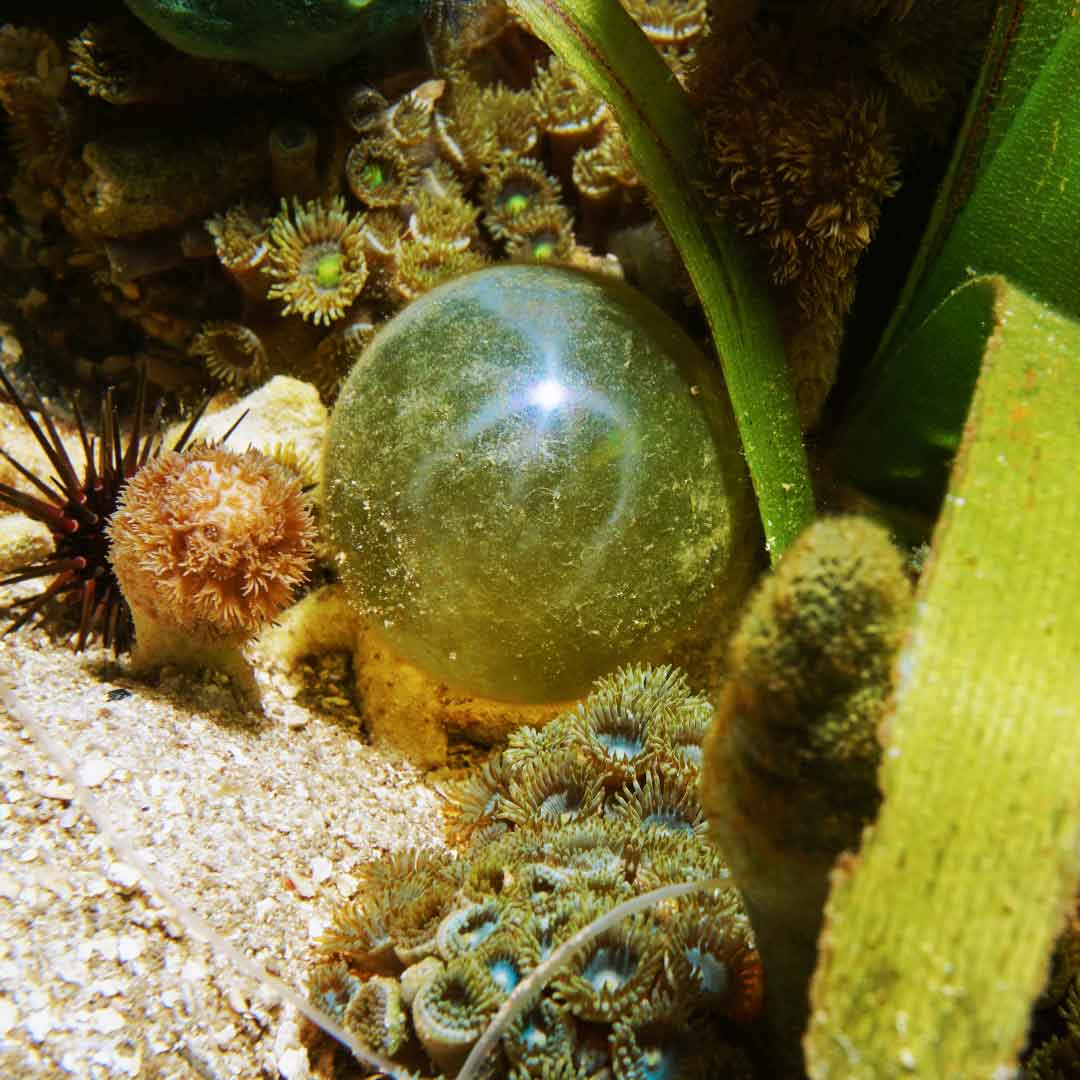
That shiny green marble tucked into a crevice on a coral reef? It is a single living cell. Not a colony. Not a cluster. One cell containing multiple nuclei, a large central vacuole, and a thin layer of cytoplasm.
Valonia ventricosa can grow up to 5 cm in diameter. For a single cell, that is enormous. It is one of the few single-celled organisms you can see, pick up, and hold between your fingers.
Because it has no internal cell walls, the cytoplasm reflects light like a polished mirror. The cellulose crystals in the cell wall produce that characteristic silvery-green sheen. This is why divers call them sea pearls.
Taxonomy
Over a century of research. One of the most studied algae in history.
Golf ball-sized. One single cell. Visible to the naked eye.
From shallow tidal pools to deeper reef walls across tropical oceans.
Sea pearls reproduce through segregative cell division. The multinucleate cytoplasm divides internally, forming smaller daughter cells. When the parent cell ruptures, each daughter grows into a new organism.
They also reproduce vegetatively: rhizoid cells can expand into tiny new vesicles that detach and become independent.
If the cell wall ruptures, every cytoplasmic fragment with a nucleus can grow into a new organism. Crushing bubble algae in an aquarium makes the problem worse, not better.
The unusually large cell size makes V. ventricosa an ideal model organism. Researchers can insert microelectrodes and study processes invisible in typical cells.
Unusually high electrical potential relative to seawater. Potassium diffusion potentials and electrogenic ion pumps studied since the 1930s.
Classic studies proved water crosses the membrane through the lipid bilayer itself, not through pores. A foundational discovery in cell biology.
Under stress, the cell actively adjusts internal ion concentrations. Sophisticated homeostasis in a single cell with implications for plant biology.
Multiple nuclei sharing a single cytoplasm. Is it one cell with many nuclei, or many cells without walls? The debate continues.
While sea pearls fascinate divers in the wild, they are one of the most frustrating pests in saltwater reef aquariums. Introduced on live rock, V. ventricosa can rapidly proliferate, smothering corals and overgrowing equipment.
Manual removal is risky. Pop a bubble and you scatter fragments that each grow into new organisms. The key is careful, intact removal with tweezers.
Remove intact with tweezers. Include rhizoids.
Most effective biological control. Spoon-shaped claws grab rather than pop.
Reduce nitrate and phosphate. Strong lighting accelerates growth.
Not strictly. Caulerpa taxifolia reaches 30 cm. Acetabularia grows to 10 cm. What makes V. ventricosa remarkable is that it maintains a simple, spherical shape. No branching, no elongation. A clean, marble-like form that is immediately recognizable as a single cell.
A shiny, translucent green sphere, typically 1-4 cm in diameter. It has a mirror-like sheen and looks like a glass marble sitting on the reef. Colours range from bright green to very dark green.
Sea pearls are harmless and not toxic. However, like all marine life, it is best not to touch them. Observe and photograph, but leave them where they are.
It rapidly proliferates, smothering corals. Popping the bubbles releases cellular fragments that each grow into new organisms. Emerald crabs are the most effective biological control.
Primarily through segregative cell division: the multinucleate cytoplasm divides internally, forming daughter cells released when the parent ruptures. Also reproduces vegetatively through rhizoid cells.
Found throughout Bahamian waters on coral reefs, rocky substrates, and mangrove roots. Particularly common on shallow patch reefs around Nassau, Andros, and the Exuma Cays. Look in crevices and under coral overhangs.
See Them in Person
Dive Bahamian reefs with PIMS scientists. See sea pearls, coral restoration, and marine conservation fieldwork firsthand.