

Eleven of twelve Bahamian seafood species are overfished. Now we finally have the numbers to prove it.
A new peer-reviewed paper in Frontiers in Marine Science, led by Dr. Maria Lourdes D. Palomares of Quantitative Aquatics in the Philippines and senior-authored by Dr. Daniel Pauly of the Sea Around Us at the University of British Columbia, delivers the first peer-reviewed, data-limited stock assessments for twelve of the most commercially and culturally important seafood species in Bahamian waters. Co-authored by PIMS scientists Dr. Krista Sherman and Dr. Craig Dahlgren, it confirms what Bahamian fishers have been saying for a generation: most of the country’s signature seafood stocks are being pulled harder than the sea can replace. Only one species, dolphinfish, comes out healthy.
The Bahamas has managed its reef and pelagic fisheries for decades without species-specific stock assessments for most of the commercial and recreational catch. It is not an oversight. Full age-structured assessments need long fishery-independent surveys, age and growth sampling, and consistent species-level catch reporting that simply do not exist for most small-scale or developing-country fisheries anywhere in the world. And so managers, fishers, vendors, cooks and diners have been making decisions about conch, grouper, snapper, hogfish and lobster without a defensible picture of how much of each stock is actually left.
This paper closes that gap for twelve species at once. Using a data-limited method called CMSY++ (Froese et al., 2023), the authors reconstructed seventy-three years of Bahamian fisheries catch, from 1950 through 2022, then asked, species by species: how much biomass is left relative to what would support the largest sustainable harvest? The results give The Bahamas its first quantitative, globally comparable baseline for managing these fisheries.
The answer is not comfortable. Of the twelve species assessed:
- Two species are “grossly overfished” — Nassau grouper and yellowfin grouper, both below 50% of the biomass that would support maximum sustainable yield.
- Six species are “overfished” — queen conch, Caribbean spiny lobster, hogfish, black grouper, rock hind and wahoo.
- Three species are “slightly overfished” — lane snapper, mutton snapper and gray snapper.
- One species is healthy — dolphinfish (mahi mahi). The paper cautions this is a shared Western Central Atlantic stock and Bahamian-water-specific numbers are not conclusive on their own.
assessed
(1950–2022)
reconstructed
overfished
Recreational fishing is a bigger slice of the Bahamian catch than most people realise
The seventy-three-year reconstruction estimates that The Bahamas has taken roughly 1.3 million tonnes of seafood out of its waters between 1950 and 2022, at an annual average of around 17,500 tonnes. The share of that catch by fishing sector is the paper’s first surprise:
- Recreational sector — 46%. Tourism-driven charter boats, sportfishing and visiting anglers are the largest single source of catch over the time series.
- Industrial sector — 26%. Dominated by the export-oriented spiny lobster fishery.
- Artisanal sector — 23%. Small-boat, small-scale commercial fishing.
- Subsistence — 5%. Food-on-the-table fishing by Bahamian residents.
Two species dominate. Caribbean spiny lobster alone accounts for 33% of the country’s total reconstructed catch, roughly 425,000 tonnes over seventy-three years. Queen conch is another 21%. Between them, these two invertebrates represent more than half the seafood The Bahamas has taken from its waters over the study period. Both are now classified as overfished: spiny lobster at 61% of the biomass that would support maximum sustainable yield, queen conch at 59%.
The reef groupers and snappers tell the hardest story. Catches of Nassau grouper, IUCN-listed as Critically Endangered since 2015, remained above the maximum sustainable yield for nearly four decades before collapsing from their mid-1990s peak. The paper finds no sign of recovery in the 2018–2022 data. Yellowfin grouper, at just 40% of the healthy reference level, is the worst-off species in the study. These species are the backbone of The Bahamas’ domestic seafood supply. Their overfished status means fewer fish in local markets and on local plates unless management action is taken.
Where each species sits on the sustainability scorecard
Values below are the ratio of current biomass to the biomass that would support maximum sustainable yield (B/BMSY), averaged over 2018–2022. A value of 1.0 or above is healthy. Values below 0.2 are considered collapsed.
| Species | B / BMSY | Status |
|---|---|---|
| Dolphinfish Coryphaena hippurus | 1.01 | Healthy |
| Lane snapper Lutjanus synagris | 0.86 | Slightly overfished |
| Gray snapper Lutjanus griseus | 0.84 | Slightly overfished |
| Mutton snapper Lutjanus analis | 0.82 | Slightly overfished |
| Wahoo Acanthocybium solandri | 0.78 | Overfished |
| Black grouper Mycteroperca bonaci | 0.66 | Overfished |
| Caribbean spiny lobster Panulirus argus | 0.61 | Overfished |
| Rock hind Epinephelus adscensionis | 0.60 | Overfished |
| Queen conch Aliger gigas | 0.59 | Overfished |
| Hogfish Lachnolaimus maximus | 0.54 | Overfished |
| Nassau grouper Epinephelus striatus | 0.49 | Grossly overfished |
| Yellowfin grouper Mycteroperca venenosa | 0.40 | Grossly overfished |
Adapted from Palomares et al. (2026), Table 7. Values are averages over the 2018–2022 period.
The paper classifies stocks on a five-step scale: healthy (B/BMSY ≥ 1.0), slightly overfished (0.8–1.0), overfished (0.5–0.8), grossly overfished (0.2–0.5), and collapsed (below 0.2). Nassau grouper and yellowfin grouper sit firmly in “grossly overfished.” Current biomass is less than half the population size the ecosystem could sustain if the fishery were managed for long-term yield.
How do you assess a stock when you don’t have the data a full assessment would need?
Traditional age-structured stock assessments, the kind used for North Atlantic cod or Pacific salmon, demand decades of fishery-independent surveys, age and growth sampling, and consistent catch reporting disaggregated by species. Most Bahamian fisheries do not have that. Neither do the vast majority of small-scale fisheries anywhere in the world.
CMSY++ (Froese, Winker, Coro, Demirel et al., 2023) was designed for this gap. It combines three things a data-poor fishery usually does have: a reconstructed catch history, expert priors on how productive each species is, and conservative assumptions about where the stock probably sat at the start, middle and end of the time series. The method sweeps the space of plausible population parameters to find combinations consistent with the catch record and the priors, then estimates maximum sustainable yield, current biomass relative to the healthy reference point, and current fishing pressure relative to the sustainable rate.
The authors did not rely on catch data alone. They strengthened their priors with long-term PIMS survey data, AGRRA (Atlantic and Gulf Rapid Reef Assessment) time series, regional stock assessments from the Gulf of Mexico and southeastern Florida, and IUCN Red List evaluations. The result is a twelve-species snapshot of Bahamian fisheries status that is peer-reviewed and globally comparable with assessments the Sea Around Us team has produced for more than 270 countries and territories.
“CMSY++ is designed for exactly this situation, a data-limited fishery where the decades of age-sampling and fishery-independent surveys needed for a full traditional assessment are not available, but reconstructed catches and careful priors are. What this work does is stop The Bahamas from flying blind on twelve of its most commercially important species at once. It is a starting point that the previous decade of good intentions and partial surveys could not provide on its own.”
Dr. Maria Lourdes D. Palomares, Lead author and manager of the Sea Around Us initiative, Quantitative Aquatics
The twelve assessed species, illustrated
Alongside the paper, PIMS produced plain-language species fact sheets for each of the twelve assessed species, illustrated by Bahamian scientific illustrator Andrew Knowles. Each card covers IUCN conservation status, habitat, reproduction, ecological role, and current stock assessment finding, written for vendors, restaurants, cooks, anglers and consumers.
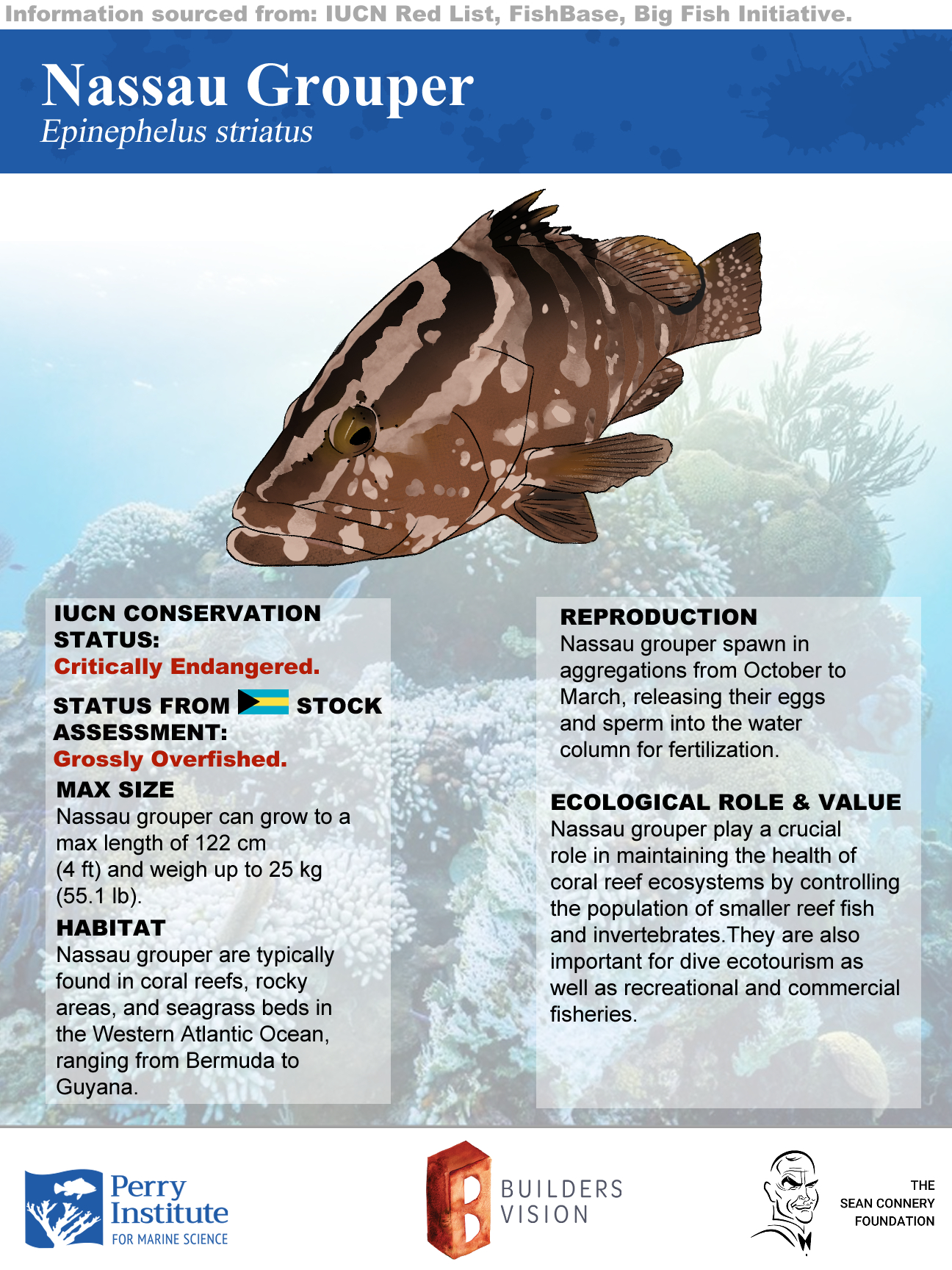
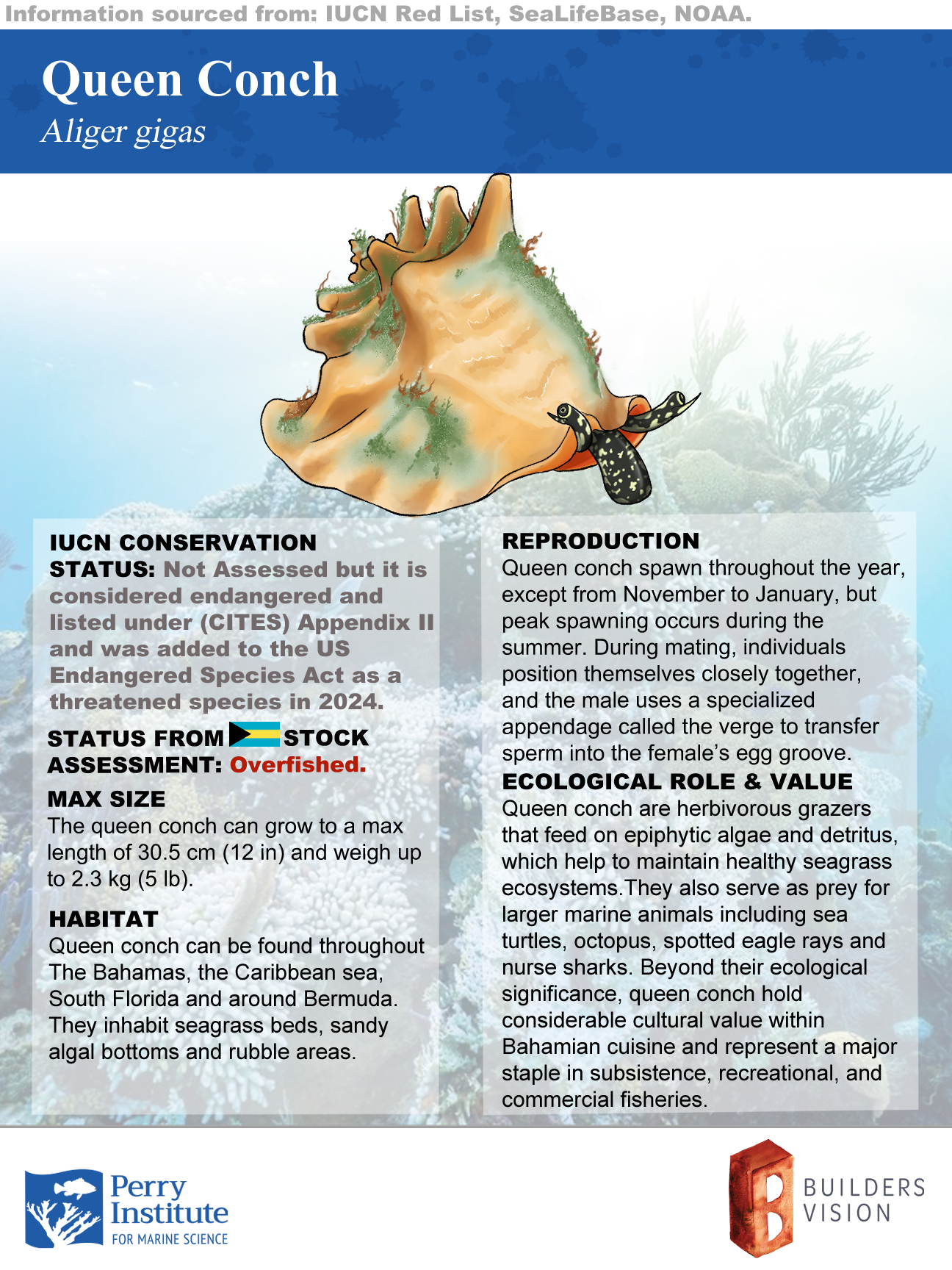
Species illustrations © Andrew Knowles for the Perry Institute for Marine Science.
Browse the PIMS species fact sheets
Plain-language cards for conch, lobster, grouper, snapper, hogfish, wahoo and more, illustrated by Bahamian scientific illustrator Andrew Knowles.
View species fact sheetsWhy this science matters for what ends up on the plate
The assessment paper is the quantitative half of a larger PIMS initiative, the Bahamian Domestic Seafood Project, funded by the Builders Initiative, aimed at giving Bahamian consumers, fishers, vendors, cooks and policymakers the information they need to shift the domestic seafood trade onto a sustainable footing.
The other half is already in public view: the short documentary Seafood Nation, directed by Matt McCoy of Loggerhead Productions, which premiered at Baha Mar in December 2025 and has continued to screen at venues across New Providence. Seafood Nation puts faces, hands, recipes and boats to the numbers, showing how deeply Bahamian culture is shaped by what the sea provides, and what is at stake if the catch keeps drawing down.
Together, the assessment paper, the species fact sheets and the documentary give the public, fishers, vendors and policymakers a shared set of tools to understand the state of these fisheries and the choices available to them.
What happens after the numbers are on the table
- ✓ Share the assessment outputs with the Bahamian Department of Marine Resources and relevant fisheries management working groups.
- ✓ Revisit Nassau grouper management with the Ministry. The grossly-overfished finding reinforces the case for stronger spawning-aggregation protection and tighter closed-season enforcement.
- ✓ Feed the quantitative results into the Bahamian Domestic Seafood Labeling consumer-facing work. The sustainability ratings on the fact sheets reflect the B/BMSY numbers from this paper.
- ✓ Continue the Seafood Nation screening and conversation series to give the public a way into this science.
- ✓ Press the case for species-specific regulations. As the paper’s authors note: “There are currently no species-specific management strategies in place for these species. Implementing targeted, species-specific regulations could help accelerate their recovery.”
Bahamian fisheries respond when management is real and enforcement is consistent
The paper is not only difficult news. Its Discussion section identifies two concrete reasons for optimism, both directly relevant to The Bahamas.
In the 2024–2025 spawning season, researchers observed a large, seemingly healthy Nassau grouper aggregation off the Ragged Islands: a remote site where the country’s closed-season regulations apply but which is fished less often because safe access requires several consecutive days of favorable weather in winter. That site, and others in remote parts of the archipelago, are exactly where targeted protection could yield disproportionate recovery.
In Little Cayman, a Nassau grouper population has more than tripled over roughly fifteen years in response to conservation, the clearest regional demonstration that local management interventions, closures and protection of spawning aggregations, can yield positive results. The paper notes that “The Bahamas has several remote FSAs and more reported sites than many other countries, which provide additional opportunities for recovery, especially when paired with regulatory reform and stakeholder support.”
“I am thrilled to have had the opportunity to collaborate with global fisheries experts, Dr. Deng Palomares and Dr. Daniel Pauly, on this stock assessment. The completion of robust stock assessments for 12 species, including 10 commercial, subsistence, and recreational fish species, as well as two commercially important invertebrates (spiny lobster and queen conch), represents a significant achievement for The Bahamas, where this information has historically been limited. These assessments not only improve our understanding of the status of key fisheries but also provide a critical foundation for the sustainable management of these valuable resources moving forward.”
Dr. Krista Sherman, Senior Scientist, Perry Institute for Marine Science
“The pattern we see in The Bahamas, a handful of species still productive, most severely depleted, and a gap between what managers can observe and what they can act on, is characteristic of reef fisheries across the tropics. What makes a difference in this case is the willingness of scientists, led by Dr. Sherman and Dr. Dahlgren at the Perry Institute, to use a rigorous, globally comparable assessment rather than wait for ideal data that may never come. The results should concern anyone who eats Bahamian seafood, and they should motivate the management reforms the country’s own scientists have been advocating for.”
Dr. Daniel Pauly, Senior co-author and founder of the Sea Around Us, University of British Columbia
Questions people ask about this research
Which species did the paper assess?
Twelve commercially and culturally important species that together represent the majority of The Bahamas’ total reconstructed catch from 1950 to 2022: Nassau grouper, black grouper, yellowfin grouper, rock hind, hogfish, mutton snapper, lane snapper, gray snapper, queen conch, Caribbean spiny lobster, dolphinfish (mahi mahi), and wahoo.
Which species are in the worst shape?
Yellowfin grouper and Nassau grouper. Both are classified as “grossly overfished,” meaning current biomass is less than half of the level that would support the largest sustainable harvest. Yellowfin grouper is at 40% of the healthy reference; Nassau grouper at 49%. Nassau grouper has also been IUCN-listed as Critically Endangered since 2015.
What does “data-limited stock assessment” mean?
Most traditional fisheries assessments require decades of age-and-growth sampling and fishery-independent survey data that do not exist for most reef and small-scale fisheries around the world. Data-limited methods like CMSY++ combine reconstructed catch histories with ecological priors to estimate sustainable yield and current stock status when the traditional inputs are not available.
What can a consumer do with these findings?
Ask questions. Where was this caught? Which species is it (mahi mahi vs. wahoo, Nassau grouper vs. black grouper, queen conch vs. farmed conch)? Was it taken in season? The PIMS species fact sheets give the plain-language version for each of the twelve species. The Seafood Nation documentary is also a good place to start.
Where can I read the paper?
The paper is open-access in Frontiers in Marine Science: doi.org/10.3389/fmars.2026.1822127. More of PIMS’ Bahamian fisheries research is at perryinstitute.org/research.
Who illustrated the species fact sheets?
Bahamian scientific illustrator Andrew Knowles. His original species graphics appear throughout the PIMS fact sheet series. Use with attribution: © Andrew Knowles for the Perry Institute for Marine Science.
What is the Sea Around Us?
The Sea Around Us is a research initiative at the Institute for the Oceans and Fisheries at the University of British Columbia, founded in 1999 by Dr. Daniel Pauly. It has produced catch reconstructions and stock assessments for more than 270 countries and territories, and developed the CMSY++ method used in this paper.
Related PIMS and Sea Around Us research
- Sherman K.D. et al. (2025). Stakeholder perspectives on status and conservation of Nassau grouper in The Bahamas. Gulf and Caribbean Research 36.
- Sherman K.D., Dahlgren C.P. et al. (2020). RAD-seq analysis and in situ monitoring of Nassau grouper reveal fine-scale population structure. Frontiers in Marine Science 7: 157.
- Dahlgren C.P., Sherman K.D. et al. (2017). Nassau grouper migration patterns during full moon suggest collapsed historic spawning aggregation. Bulletin of Marine Science 93.
- Sherman K.D., Dahlgren C.P. et al. (2018). Contemporary and emerging fisheries in The Bahamas. Fisheries Management and Ecology 25(5): 319–331.
- Browse the full PIMS publication library.
Support the fisheries science that makes this possible
PIMS’ fisheries programme has spent more than a decade building the science Bahamian managers and communities need. Every survey, every assessment, every screening of Seafood Nation, is underwritten by people like you.
Support PIMSAcknowledgements. Species illustrations by Andrew Knowles (© Andrew Knowles for the Perry Institute for Marine Science). Stock assessments led by Dr. Maria Lourdes D. Palomares and the team at Quantitative Aquatics in collaboration with Dr. Daniel Pauly and the Sea Around Us initiative at the University of British Columbia. Bahamian fisheries science led by PIMS co-authors Dr. Krista D. Sherman and Dr. Craig P. Dahlgren. The Bahamian Domestic Seafood Project is supported by the Builders Initiative. Sea Around Us is additionally supported by the Beagle Charitable Foundation, the David and Lucile Packard Foundation, the Marisla Foundation, the Oak Foundation and the Summit Foundation.
How to cite this paper. Palomares, M.L.D., Parducho, V.A., Abucay, L., Sherman, K., Dahlgren, C., and Pauly, D. (2026). The marine fisheries resources in The Bahamas: Reconstructed catches 1950 to 2022 and status of traditionally and recreationally important species. Frontiers in Marine Science 13:1822127. doi.org/10.3389/fmars.2026.1822127
